Flat Roof Replacement in Dublin
EPDM, GRP and Felt Costs for Rear Extensions in Ranelagh, Rathmines and Drumcondra

EPDM, GRP and Felt Costs for Rear Extensions in Ranelagh, Rathmines and Drumcondra
For a typical Dublin rear-return or kitchen-extension flat roof (12–25 m²), indicative 2025 replacement costs are €90–€130 per m² for torch-on felt, €110–€150 per m² for EPDM rubber, and €130–€180 per m² for GRP fibreglass, fully fitted with new firrings, insulation upgrade and lead or GRP upstands to the parapet. For a fixed-price quote on your specific roof, call 01 2657795 or request a site visit.
Those bands cover the vast majority of jobs we survey in Ranelagh, Rathmines, Rathgar, Ranelagh village, Drumcondra and the wider inner-south and northside terraces. Access, parapet height, box gutter condition and whether you need to strip back to joists all move the price. Treat the figures as indicative — confirm exact rates after a survey.
Most flat roofs we replace in Dublin sit on one of two housing types: the Victorian and Edwardian red-brick terraces of Ranelagh, Rathmines, Portobello and Drumcondra (built roughly 1880–1910, with two-storey rear returns), or the 1930s–1950s semi-detached homes further out in Terenure, Templeogue and Drumcondra's Griffith Avenue side. Both share the same weak points: shallow falls, parapet walls with old lead cover flashings, and box gutters hidden behind the parapet that dump water into a single hopper.
Dublin gets roughly 750–850 mm of rain a year, spread across 150+ wet days. That constant wetting-drying cycle is what kills three-layer felt after 15–20 years and opens splits at the parapet upstand long before the field of the roof fails. A proper re-roof isn't just a new membrane — it's fixing the falls, the box gutter and the detailing at the same time.
If you're weighing up your options for Ranelagh flat roofing, the material choice matters less than the detailing at the edges. Get the parapet and gutter right and any of the three systems below will last its full design life.
EPDM (ethylene propylene diene monomer) is a single-ply synthetic rubber, usually laid in one piece for roofs under about 40 m² so there are no field joints. On a standard Ranelagh return of 15–18 m², a Firestone or Classic Bond sheet covers the whole roof with only bonded upstands at the parapet and abutment.
GRP (glass reinforced polyester) is laid wet as a laminate of resin and chopped-strand mat over an 18 mm OSB3 deck, then topflow coated. It cures to a seamless, walkable surface — genuinely useful for the small flat roofs used as balconies off first-floor bedrooms in refurbished Rathmines and Ranelagh terraces.
Modern torch-on isn't the mineral felt of the 1980s. A proper three-layer system — vapour barrier, underlay and mineral cap sheet — from a supplier like IKO or Bauder is a serious, code-compliant roof. It's still the most common spec on Dublin period terraces because it handles the parapet-to-box-gutter transition better than any other system.
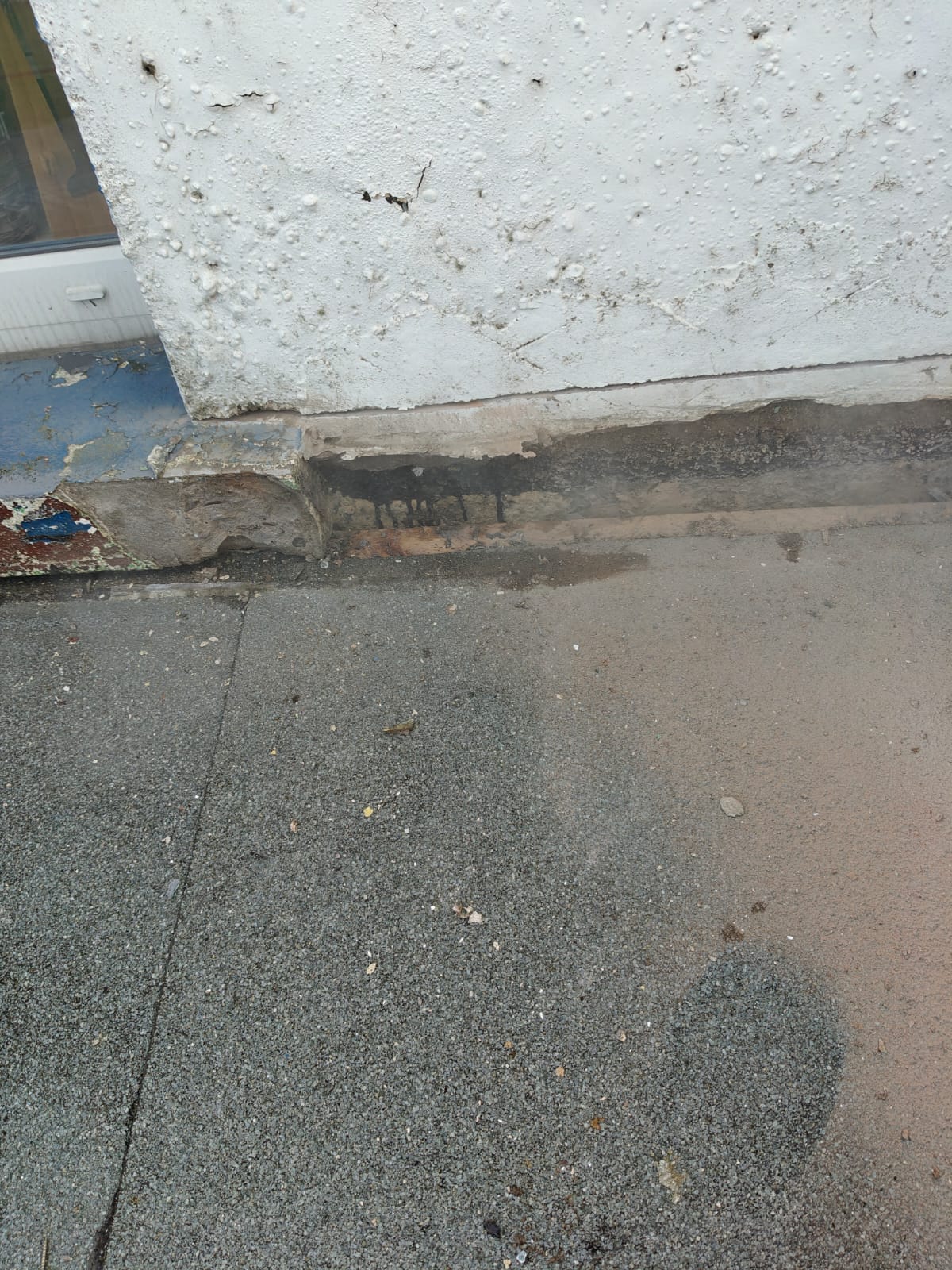
This is where 80% of Dublin flat roof failures start. A red-brick parapet in Ranelagh or Rathmines has probably had three or four repairs over its life: patched lead, mastic smears, sometimes a fillet of sand-and-cement that's cracked and let water track behind the upstand.
On a proper re-roof we treat the parapet and box gutter as one detail:
Get this wrong and the roof will leak within two winters regardless of what membrane you chose. Get it right and it'll outlast the warranty.
A flat roof replacement in Ireland must meet Part L of the Building Regulations — currently a maximum U-value of 0.20 W/m²K for a refurbished flat roof element. In practice that means 120–140 mm of PIR insulation (Kingspan Thermaroof, Xtratherm or Recticel) on top of the existing deck as a warm roof build-up.
Warm roof construction is now standard for Dublin rear extensions because it avoids the interstitial condensation problems that plagued cold-roof designs in the 1990s and 2000s. Expect an extra €25–€40 per m² for the insulation and vapour control layer on top of the membrane cost.
Falls should be minimum 1:80 to any outlet, though we spec 1:60 as standard on box gutters. Anything flatter than 1:120 will pond, and ponding shortens the life of any membrane by roughly a third.
Rathmines, two-storey Victorian return, 14 m²: Stripped three failed layers of felt, replaced 40% of deck timbers, installed 120 mm PIR warm roof, laid EPDM in a single sheet with code 5 lead cover flashing to the parapet. Total: €3,650 including VAT and a new cast aluminium hopper. Twenty-year manufacturer warranty.
Drumcondra, 1930s kitchen extension, 22 m²: GRP was ruled out because the survey was in February and decking moisture was 22%. We installed a three-layer IKO torch-on system with new firrings giving a 1:50 fall, GRP simulated-lead trim to the parapet, and a widened box gutter. Total: €2,980 including VAT. Fifteen-year insurance-backed guarantee.
Both jobs took three to four working days. Neither needed scaffolding beyond a tower to the rear — a real cost saving on tight terraced-house sites.
You can sanity-check figures using our roofing cost calculator before booking a survey.
We survey flat roofs across Ranelagh, Rathmines, Rathgar, Drumcondra, Portobello and the wider south city daily. Every quote is fixed-price after a physical survey — no day rates, no surprises. See recent projects on our gallery of completed roofing work, or read more about our full range of residential roofing services in Dublin.
Ready to book a survey? Homeowners in Ranelagh, Rathmines and the surrounding area can request a free, no-obligation quote from our Ranelagh roofing team, or contact us directly on 01 2657795.
We also wrote “Roof Repair & Replacement Costs in Dublin: 2026 Price Guide” on our Blogger page.
Most 15–25 m² rear-return or kitchen-extension roofs take three to four working days from strip to final flashings. Weather-sensitive systems like GRP add a day in winter. Access through the house rather than a side passage typically adds half a day of labour.
Only if the felt is dry, well-bonded and the falls are correct — which is rare on a 20-year-old Dublin roof. Overlaying also means you can't upgrade insulation to Part L standards, so we almost always recommend a full strip and warm-roof rebuild.
Like-for-like replacement is exempt development. If you're changing the roof profile, adding rooflights over a certain size, or the property is a protected structure (common in parts of Rathmines and Ranelagh), you may need permission or a Section 5 declaration from Dublin City Council. We'll flag this at survey stage.
Both are 25–30 year systems when detailed correctly. EPDM handles building movement better, so it wins on older properties with settlement. GRP wins where the roof gets foot traffic or where a hard, seamless finish is needed at parapet trims.
Yes — a properly specified three-layer SBS system from IKO or Bauder is entirely fit for purpose on Dublin period properties, especially where box gutters and complex parapet details make single-ply membranes harder to detail. It's also the most cost-effective option by €20–€40 per m².
SEAI grants apply to insulation upgrades, not roofing itself. However, if your flat roof replacement includes a warm-roof insulation upgrade meeting the required U-value, the insulation element may qualify under the One Stop Shop scheme when combined with other fabric upgrades. Worth discussing with an SEAI-registered contractor.
Roof Repairs in Dublin, Ireland. Free survey, written fixed-price quote, 10-year guarantee.