Moss, Lichen and Algae on Limerick Roofs
Why Shannon Estuary Damp Grows Green Roofs in Castletroy, Raheen and Corbally — and How to Clean Slate Safely

Why Shannon Estuary Damp Grows Green Roofs in Castletroy, Raheen and Corbally — and How to Clean Slate Safely
Indicative 2026 price range, Limerick, in euro. VAT at 13.5% applies on top.
Flat roof crack repair in Limerick city centre: water already getting through before work began.
Limerick sits in a specific microclimate. The Shannon Estuary funnels moist Atlantic air inland, and Met Éireann data puts Shannon Airport at around 977mm of annual rainfall with relative humidity above 80% for most of the year. That is not just rain, it is persistent surface dampness. Slate, concrete tile and clay never get the long dry spells they would get in the east midlands.
Three things combine to feed the growth:
The result: a slate roof that would stay clean for 20 years in a drier climate can go visibly green here in 6 to 8.
Not every suburb suffers equally. The pattern is predictable across the roofs we cover:
If your house is in one of these areas and you can see green from the footpath, it is the climate. What you do about it is what matters.
These three get lumped together but they behave very differently on a roof.
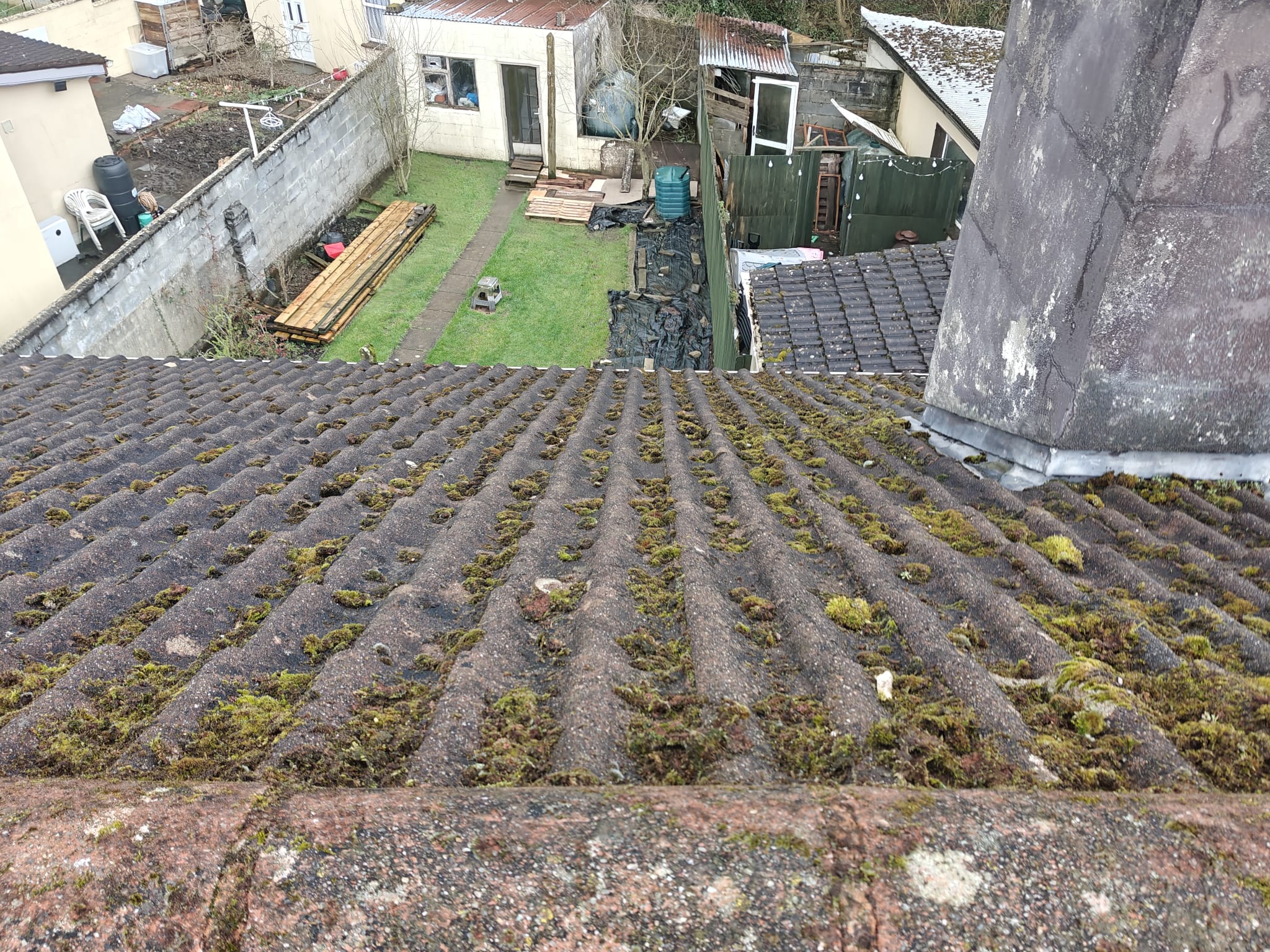
Moss is the cushiony green growth. It holds water like a sponge, and a well-mossed slate roof can carry significant extra weight when saturated. It also wicks water sideways under the slate laps, which is how you get ceiling stains with no obvious hole above.
Lichen is the pale grey, crusty, circular growth. It is a fungus and an algae living together, and it bonds chemically to slate and clay. You cannot pressure-wash it off without taking surface material with it. Lichen is mostly cosmetic on a healthy slate but it is a sign the roof stays damp.
Algae is the black streak down concrete tiles, usually Redland or Sandtoft tiles from the 1980s. It feeds on the limestone filler in the tiles and accelerates surface erosion over 10 to 15 years if left untreated.
Different growth, different treatment. Anyone who quotes one price for roof cleaning without looking at which of the three you have is guessing.
Do not let anyone put a pressure washer on a Bangor Blue, Killaloe or Welsh slate roof.
Slate is a laminated stone, thin layers pressed together. A jet washer at 2,000+ PSI drives water between those layers and blows the surface off. You will see it come away as grey dust in the runoff. Within two or three winters, the exposed inner layer starts to delaminate and the slate cracks along its natural bedding plane. You have taken decades off a roof that had plenty of life left.
The same applies to the nails. Copper and galvanised nails hold slates through a small hole in the top edge. Pressure washing floods the batten space, corrodes the fixings and causes nail sickness years early. That is when slates start slipping in every gale, and the only fix at that point is a full re-roof.
Concrete tiles handle pressure washing slightly better, but you will strip the factory colour coat and the roof will re-green within 18 months because the exposed concrete is more porous than before.
Here is the method used across Castletroy, Raheen, Corbally and the wider Limerick area:
Indicative 2026 pricing for roof repair and treatment work, including moss cleaning and biocide application, sits within our general roof repair range of €400 to €2,500 depending on roof size, pitch, access and the extent of growth. All prices are indicative and confirmed after a free survey. VAT at 13.5% applies on top.
A full re-roof, by contrast, starts around €8,000 to €18,000 for concrete tile or €12,000 to €28,000 for natural slate. The case for doing routine maintenance properly is not complicated.
Sometimes the roof is past the point where a clean helps. Signs to watch for:
In those cases a clean is throwing good money after bad. See our guide to roof replacement in Limerick and our slate and tile roofing prices in Limerick for what is involved in a larger job, or browse our gallery of completed roofing work to see both cleaning and replacement outcomes.
For most Limerick homes, a proper biocide treatment every 5 to 7 years keeps the roof visually clean and the gutters clear. North-facing pitches or heavily shaded properties, such as the treeline properties in Castletroy or along the Corbally Road, may need a lighter touch-up at year 3.
Gutters are a separate conversation. They should be cleared twice a year, in autumn and late spring, particularly where moss is present, because that is where the mass ends up once it loosens.
Every repair we carry out in Limerick comes with a written guarantee: a minimum of 3 years, and up to 10 years on major repair work. Replacement work carries a 10-year guarantee as well as the Lifetime Leak Guarantee. We employ our own crews directly and do not subcontract, so the people on your roof are our people and the guarantee has a face behind it. You can read what Limerick customers say on our reviews page and see completed jobs in our case studies.
This problem is not unique to Limerick. If you have a property elsewhere, our equivalent guides cover the same ground for each city:
If you are in Castletroy, Raheen, Corbally, Caherdavin, Dooradoyle or anywhere across Limerick city and county, call our Limerick team on 061 788600 or visit our contact page to book a free survey. We will inspect the roof, tell you honestly whether a clean or a repair is the right call, and give you a written fixed-price quote with no pressure attached.
Yes, indirectly. Moss holds moisture against the slate and in the batten space below. In freeze-thaw cycles that moisture expands, opens micro-cracks and accelerates delamination. It also blocks gutters and lifts slates off their laps in high wind.
Moss removal and biocide treatment falls within our general roof repair range of €400 to €2,500, depending on roof size, pitch, access and the extent of growth. The exact figure is confirmed after a free survey. VAT at 13.5% applies on top. We do not quote a firm price without seeing the roof.
No. A jet washer at high pressure drives water between the laminated layers of slate and can cause irreversible delamination within a few winters. It also floods the batten space and accelerates nail corrosion. The safe method is a soft scrape and a low-pressure biocide treatment.
We use quaternary ammonium or benzalkonium chloride solutions applied by low-pressure knapsack sprayer. Reputable roof biocides at working dilution are approved for domestic use, but we sheet off ponds, vegetable beds and rainwater butts before spraying. Tell us if you harvest rainwater.
Most Limerick homes need a proper biocide treatment every 5 to 7 years. North-facing or heavily shaded pitches may need a lighter touch-up at year 3. Gutters should be cleared twice a year, in autumn and late spring.
If slates lift with a finger, multiple slates are cracked or delaminating, the ridge sags, or you have interior damp patches, cleaning is the wrong first step. In those cases we will tell you straight and explain the repair or replacement options. See our guide to roof replacement in Limerick for what is involved.
Generally no. Insurers treat moss growth as a maintenance issue, and claims for leaks traced back to unmaintained moss are often refused. Routine treatment is far cheaper than the repair costs that follow when moss is left.
We would advise against it. Slate roofs are hazardous when wet or mossy and working at height carries serious risk. Uneven biocide application also leaves patchy regrowth. Use an insured contractor.
Repairs carry a written guarantee of a minimum of 3 years, up to 10 years on major repair work. Replacement work carries a 10-year guarantee and the Lifetime Leak Guarantee. All guarantees are in writing before contracts are signed.
No. A quote visit for work we could carry out is free and comes with no obligation. We inspect the roof, give you our findings in writing, and quote a fixed price. A standalone pre-purchase or insurance inspection report may be chargeable, ask when you call.
Ask three questions: what biocide are they using and is it approved for slate; are they scraping or pressure washing; and will they inspect and quote separately for any repairs found during the clean. If they cannot answer clearly, call someone else.
Yes. We cover Limerick city and the surrounding suburbs including Castletroy, Raheen, Dooradoyle, Corbally, Caherdavin, Annacotty and Mungret, as well as county towns such as Newcastle West, Adare and Kilmallock.
Roof Repairs in Limerick, Ireland. Free survey, written fixed-price quote, 10-year guarantee.