Pre-Winter Roof Inspection in Dublin: What to Check on 1930s Semis in Drumcondra, Cabra and Marino
If you own a 1930s red-brick semi in Drumcondra, Cabra or Marino, a pre-winter roof inspection should focus on five things: hip tile bedding, valley lead condition, chimney flashings, slipped Bangor Blue slates, and gutter falls. Do it before the November Atlantic gales. Book a proper roof inspection by mid-October, or call us on 01 2657795 for a fixed-price quote.
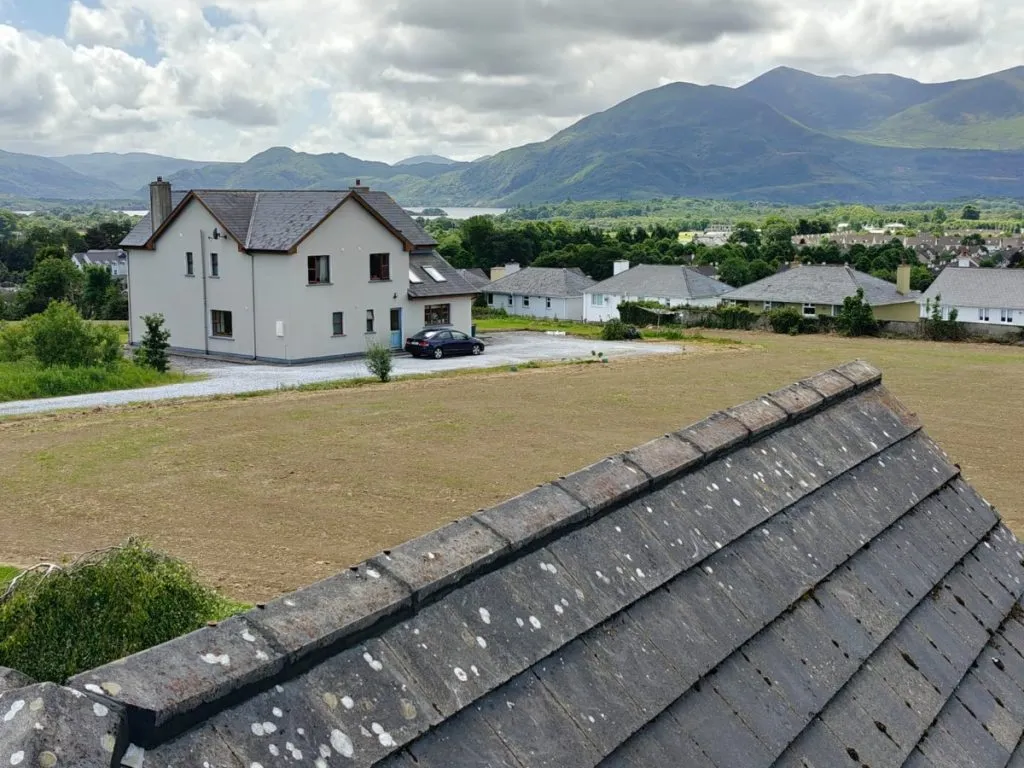
Leaking Slate Roof in Tyrrellstown, Full Replacement Starts Tyrrellstown, Dublin
Pre-Winter Roof Inspection in Dublin at a Glance
Book your inspection between mid-September and mid-October so remedial work can be completed before the November Atlantic weather arrives.
The five-point check for 1930s Drumcondra, Cabra and Marino semis covers hip tile bedding, valley lead condition, chimney flashings, slipped Bangor Blue slates, and gutter falls.
A quote visit for any work we would then carry out is free and no obligation; a standalone written inspection report is chargeable (confirm the fee when booking).
Roof leak repairs range from €400 to €2,500 (indicative 2026 figures, VAT at 13.5% on top); emergency storm damage work ranges from €1,500 to €8,000.
Parts of Marino Crescent and the Griffith Avenue houses are architecturally protected, so any material change such as swapping Bangor Blue slate for concrete tiles requires clearance from Dublin City Council Planning.
Leaking Slate Roof in Tyrrellstown, Dublin, Full Replacement Starts
Why 1930s Dublin Semis Need Their Own Checklist
The housing stock across Drumcondra, Cabra, Marino, Fairview and parts of Glasnevin is remarkably consistent. Most of it went up between 1927 and 1939 under Dublin Corporation's post-independence housing drive. Marino was the first major scheme, followed by the Cabra and Drumcondra Corporation builds. Red-brick or roughcast walls, hipped roofs, clay ridge and hip tiles bedded in sand-cement mortar, and Bangor Blue Welsh slate as the standard covering.
Ninety-odd years on, that original specification is at the end of its service life. Bangor Blue slate itself is famously durable, but the fixings, the mortar bedding, and especially the lead flashings rarely make it that far without intervention. Any one of: nail sickness, hip tile slippage, or perished valley lead will let water in over a wet winter.
Dublin winters are defined by short, sharp Atlantic lows rolling in from the west and south-west. November through February is when things break. A gable-end hip that has been quietly loose since summer can let go in a winter storm, so getting up and having a proper look in October is money well spent.
The Five-Point Pre-Winter Check
1. Hip Tile Bedding and Mechanical Fixing
The hipped roof is the defining feature of these houses, and the hip tiles, half-round or angular clay units running from ridge down to eaves, are almost always bedded in a sand-cement mortar from the original build. That mortar is now 85 to 95 years old.
What to look for:
Hairline cracks along the mortar bed, especially on the south and west-facing hips
Tiles that rock slightly under hand pressure, which should only be checked from a scaffold rather than from the tip of a ladder
Missing pointing at the tile-to-slate junction
Any tile that is visibly out of line with its neighbours
Modern best practice is mechanical fixing, with hip tiles screwed or clipped rather than relying on mortar alone. If a roofer is quoting only for rebedding and not for mechanical fixings, ask why. For a fixed price on a hip tile job on your semi, request a free written quote.
2. Valley Lead Condition
Where the main roof meets a rear return or a projecting bay, you will find a lead valley. On a 1930s semi, that lead has been expanding and contracting through decades of Dublin winters. It cracks along the centre line, splits at the laps, and eventually pinholes.
Get up close and check for:
Longitudinal splits, a dead giveaway of thermal fatigue
White oxide bloom that flakes off in your hand
Debris dams from moss and leaf fall, a particular issue near the mature trees on Griffith Avenue and Philipsburgh Avenue
Any sign of tar or silicone repairs, which trap moisture and accelerate failure
When valley lead is renewed it should be properly dressed with welted edges. For repair and replacement cost guidance, see our roof repair cost guide.
3. Chimney Flashings and Stack Condition
Almost every 1930s semi has at least one chimney stack, often two. The lead soakers, step flashings and back gutter around that stack are the single most common leak point we find. Original flashings were often under-specified and the mortar fillets that many well-meaning owners have applied over the decades crack within two winters.
Check for:
Cracked or missing step flashings
Mortar fillets in place of proper lead work, which is a red flag
Spalling brickwork on the stack itself, particularly the windward face
Loose or missing flaunching around the pots
Daylight visible where the stack meets the slate
If the brickwork needs repointing at the same time as a re-flash, that is best done in the same visit. See our guide to lead flashing and chimney aprons in Dublin for more detail on what good chimney work involves.
4. Slipped or Cracked Bangor Blue Slates
Bangor Blue is Welsh slate from the Penrhyn quarry, thin, dense and dark blue-grey. The slates themselves usually outlast the copper or iron nails holding them up. When nails corrode, slates slip. This is nail sickness, and it is the number one reason a 1930s Dublin roof needs attention.
Signs of nail sickness:
Two or three slates missing in a random pattern (not storm damage, which clusters)
Slates appearing in the gutter or on the ground after any breeze
A slight sagging or wavy line to the courses when viewed from the footpath
Rust streaks down the slate face
If you are losing more than five to ten slates a year across the roof, you are past patch-repair territory and into strip-and-relay. On a Blanchardstown job we filmed the strip as it began so the condition of the battens and felt underneath was on the record rather than described afterwards. The same principle applies on any 1930s roof: what is under the slates matters as much as the slates themselves.
A full re-roof on a standard 3-bed semi in Marino using reclaimed Bangor Blue slate is covered in our Dublin slate and tile roofing prices guide. New roof costs for Dublin houses more broadly are in our 2026 new roof cost guide. For a fixed price on your own house, get a written quote.
5. Gutters, Downpipes and Fascia
The original cast-iron half-round gutters on these houses are mostly gone, replaced piecemeal with uPVC over the years. Check that:
Falls run correctly toward the downpipe, a spirit level along the run tells you quickly
Joints are not dripping onto the render below, look for green algae streaks as a giveaway
Downpipes discharge into a gully, not straight onto the path
Fascia and soffit timbers are not soft, probe with a screwdriver at the corners
Blocked gutters are what turn a small flashing defect into a saturated bedroom ceiling. On a Stillorgan job, what looked like a gutter problem from the ground turned out to be rotten timber behind the fascia: the gutters had pulled away from the boards, not the other way around. Clear gutters in October and make sure the boards they hang from are sound.
When to Book and What to Expect
Book the inspection between mid-September and mid-October. That gives you time to schedule any remedial work before the weather closes in. Trying to get lead work done in a wet, windy January means waiting for a dry window, paying more for access, and often getting a worse result.
An inspection on a standard semi should include a roof-level survey (not just binoculars from the garden), photographs of every defect found, and a written report. A quote visit for work we would then carry out is free and no obligation. A standalone written inspection report, not tied to any follow-on job, is chargeable: confirm the fee when you call.
The ranges below are indicative 2026 figures. Every job is priced on site after a free inspection. VAT at 13.5% applies on top.
Roof Repair Cost Ranges in Dublin
Indicative 2026 price range, Dublin, in euro. VAT at 13.5% applies on top. Every job is priced after a free on-site inspection.
Roof leak repair€400 to €2,500
€400 to €2,500
Emergency storm damage work€1,500 to €8,000
€1,500 to €8,000
Emergency tile/slate securing (temporary)€200 to €500
Emergency weatherproofing€300 to €800
Emergency structural safety assessment€200 to €400
€0€2k€4k€6k€8k
Ranges from the Recommended Roofing pricing guide, 2026. Actual cost depends on access, extent of damage and materials required.
Local Considerations: Drumcondra, Cabra and Marino
Drumcondra (D9): The stretches along Hollybank Road, Ferguson Road and the roads off Grace Park have particularly tall stacks and steep roof pitches. Mature trees mean valley debris is a bigger issue here than elsewhere, so clearing moss and leaf build-up from valley leads is not optional.
Cabra (D7): The Corporation estates around Fassaugh Avenue and Ratoath Road were built to a tighter budget than Marino. Original lead work was lighter gauge, so flashings tend to fail earlier. Chimney stack repointing is very common on these streets.
Marino (D3): The Marino Crescent and Griffith Avenue houses are architecturally protected in parts. Check with Dublin City Council Planning before any material change: moving from Bangor Blue to a concrete tile substitute is not permitted on protected terraces without consent.
For homeowners across the northside and inner city, our wider Dublin repairs service is at repairs, and our guide to vetting a roofer in Dublin covers what to check before you appoint anyone.
Our Guarantee on This Work
Repair work carries a written guarantee of a minimum of three years, and up to ten years on major repair work. Any job that involves a full roof replacement carries our ten-year workmanship guarantee plus the Lifetime Leak Guarantee. The guarantee is handed over in writing before contracts are signed, not promised afterwards. Our crews are directly employed: the people on your roof are our people, not subcontractors.
You can read what Dublin customers say on our reviews page, and see how similar jobs were handled in our case studies.
“Really happy with service provided. They were extremely helpful and efficient from start to finish. An assessment and quote were provided the day after I first got in touch, and the repair was completed within a week. The issue and proposed solution were clearly explained, and I really appreciated that they recommended a proportionate repair rather than simply suggesting everything needed to be replaced. Very professional, straightforward and efficient service. Would definitely recommend!”Alice Daniels, Dublin, ★★★★★ on Google
Roof Repairs in Other Cities
If you are looking for the same level of pre-winter inspection and repair work outside Dublin, we cover Cork, Limerick and Galway with the same directly employed crews and written guarantees:
How often should a 1930s Dublin semi have a roof inspection?
Every three to five years for a roof in reasonable condition, and annually once it is over 80 years old or if you have had previous slippage. After any severe storm, do a visual check from the ground and call if anything looks out of place.
Is a pre-winter roof inspection in Dublin free?
A quote visit for work we would then carry out is free and no obligation. A standalone written inspection report, with no follow-on job attached, is chargeable. Confirm the fee when you book.
What is nail sickness and how do I know if my Bangor Blue slates have it?
Nail sickness is what happens when the iron or copper nails fixing your slates corrode through age. The slates themselves are usually fine; it is the fixings that fail. Signs include slates missing in a random pattern rather than clustered in one area, slates appearing in the gutter after a moderate breeze, and rust streaks down the slate face.
What is the difference between nail sickness and storm damage?
Storm damage clusters: you lose several slates from one area in a single event. Nail sickness is random and gradual, one slate here, two there, over months. Nail sickness means the whole fixing system is failing; storm damage is typically a targeted repair job.
How much does a roof leak repair cost in Dublin?
Indicative 2026 ranges are €400 to €2,500 for a roof leak repair, and €1,500 to €8,000 for emergency storm damage work. VAT at 13.5% applies on top. Every job is priced after a free on-site inspection.
Do I need planning permission to re-roof my Marino semi?
Not usually, as long as you are using the same material (slate for slate). If the house is on a protected structure list or in an Architectural Conservation Area, parts of Marino Crescent are, check with Dublin City Council Planning first. Changing to concrete tiles almost always requires consent on protected streets.
Are Bangor Blue slates worth reusing on a re-roof?
Yes, if they are sound. A slater will sort salvageable slates from cracked ones. Reusing original Bangor Blue maintains the visual match, which matters particularly on architecturally protected streets in Marino. The alternative is new natural slate or a fibre-cement slate; concrete tile is not a like-for-like substitute on these houses.
Can I get a grant for roof work on an older Dublin home?
Roof repair itself is not grant-aided. If you are doing attic insulation as part of the works, the SEAI Better Energy Homes scheme may cover some of that cost. Check current eligibility at the SEAI grants page at https://www.seai.ie/grants/ before applying. Confirm current figures with SEAI directly.
What happens if my chimney flashings have mortar fillets instead of lead?
Mortar fillets crack within a winter or two and do not flex with the stack the way lead does. They need to be stripped back and replaced with proper lead step flashings and soakers. It is a common find on 1930s semis across Drumcondra, Cabra and Marino, and the fix is straightforward.
How do I know if my gutter problem is actually a fascia timber problem?
If your gutters are sagging or pulling away from the wall, probe the fascia board with a screwdriver at the corners and ends. If it goes in easily, the timber is rotten and re-hanging the gutter onto it will only last one winter. The timber needs to come out and be replaced first.
Does Recommended Roofing subcontract work in Dublin?
No. The people on your roof are directly employed by us. We do not subcontract. That is one of the things we actively encourage customers to ask any roofer before appointing them.
What guarantee do repairs on a 1930s Dublin semi carry?
Repair work carries a written guarantee of a minimum of three years, and up to ten years on major repair work. If a job involves a full roof replacement, it carries our ten-year workmanship guarantee plus the Lifetime Leak Guarantee. Both are automatic and in writing before any contract is signed.